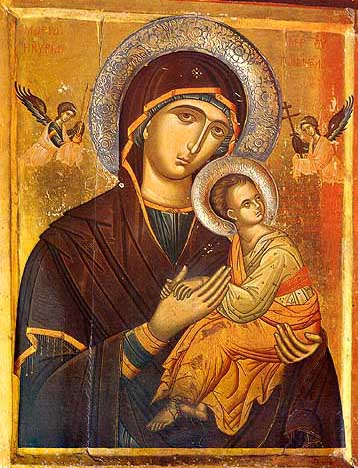
Today we will turn to that oldest, most popular of the Little Offices, which is also the one which has long been a part of the Church's liturgy. Of course, that is the Little Office of the Blessed Virgin Mary (not to be confused with the much shorter Little Office of the Immaculate Conception).
The last edition of this Little Office was published with the Breviary reforms of 1961. It was not revised in the wake of the post-Conciliar reforms. Nevertheless, it is indulgenced even in the latest version of the Enchiridion. One version of this text may be found here.
The earliest reference to an Office of the Blessed Virgin Mary was in the eighth century at Benedictine monastery of Monte Cassino. As this devotion originated in monastic communities, it was common to pray the Hours of the Blessed Virgin Mary immediately after the Hour of the Divine Office itself. For laity living in the world, one can imagine that it might be rather difficult to undertake this practice, especially as the Little Office is as long as the Hours in the Divine Office (though Matins is sometimes longer). However, as the text is generally identical from day to day (with some daily changes to the psalms in Matins, as well as seasonal changes for Advent and Christmas, plus some other minor variations) it became popular for use among the laity in place of the Divine Office. One can understand that it would be much easier to use than the full Divine Office, leading to its more frequent use.
It came to be found in the devotional books of the laity, especially Books of Hours. For instance, it was one of the major components of the English Book of Hours known as The Prymer. It was accompanied by the Office of the Dead, Litany of Saints, Penitential Psalms, and Gradual Psalms, all devotions which would have originated (with the exception of the Litany) with monastic communities.
There are certainly some great places to go for information on this particular Little Office. Theo Keller's site certainly provides some good background. The blog Psallite Sapienter provides some good reviews of different editions. Despite the critique of the Baronius Press edition on that blog, I find it refreshing to have ready access to the chants (even if the psalms are unfortunately not fully pointed for chanting). It should be noted that the Carmelites continue to have their own version of the Little Office of the Blessed Virgin Mary. It seems to me that, for Catholics generally, it is best to use the 1961 Roman version.
In keeping with the practice of our forerunners, this Little Office would be excellent at any time. However, those times during which it would most be appropriate on Saturdays, during the months of May, October, and December. While the Little Office of the Immaculate Conception would also be good to use during this last month, the particular Advent character of the Little Office of the Blessed Virgin Mary argues for its use as well.
This should wrap up our series on the Little Offices. For the other Little Offices, see the following links:
The last edition of this Little Office was published with the Breviary reforms of 1961. It was not revised in the wake of the post-Conciliar reforms. Nevertheless, it is indulgenced even in the latest version of the Enchiridion. One version of this text may be found here.
The earliest reference to an Office of the Blessed Virgin Mary was in the eighth century at Benedictine monastery of Monte Cassino. As this devotion originated in monastic communities, it was common to pray the Hours of the Blessed Virgin Mary immediately after the Hour of the Divine Office itself. For laity living in the world, one can imagine that it might be rather difficult to undertake this practice, especially as the Little Office is as long as the Hours in the Divine Office (though Matins is sometimes longer). However, as the text is generally identical from day to day (with some daily changes to the psalms in Matins, as well as seasonal changes for Advent and Christmas, plus some other minor variations) it became popular for use among the laity in place of the Divine Office. One can understand that it would be much easier to use than the full Divine Office, leading to its more frequent use.
It came to be found in the devotional books of the laity, especially Books of Hours. For instance, it was one of the major components of the English Book of Hours known as The Prymer. It was accompanied by the Office of the Dead, Litany of Saints, Penitential Psalms, and Gradual Psalms, all devotions which would have originated (with the exception of the Litany) with monastic communities.
There are certainly some great places to go for information on this particular Little Office. Theo Keller's site certainly provides some good background. The blog Psallite Sapienter provides some good reviews of different editions. Despite the critique of the Baronius Press edition on that blog, I find it refreshing to have ready access to the chants (even if the psalms are unfortunately not fully pointed for chanting). It should be noted that the Carmelites continue to have their own version of the Little Office of the Blessed Virgin Mary. It seems to me that, for Catholics generally, it is best to use the 1961 Roman version.
In keeping with the practice of our forerunners, this Little Office would be excellent at any time. However, those times during which it would most be appropriate on Saturdays, during the months of May, October, and December. While the Little Office of the Immaculate Conception would also be good to use during this last month, the particular Advent character of the Little Office of the Blessed Virgin Mary argues for its use as well.
This should wrap up our series on the Little Offices. For the other Little Offices, see the following links:


 Posts
Posts